Nuestros proyectos
Explore la experiencia de Particip en proyectos desarrollados en distintos países, sectores y ámbitos de especialización.
Nuestras referencias ofrecen una visión general de las misiones finalizadas y en curso, incluidos sus objetivos, alcance geográfico, duración y valor contractual.
Mostrando 381–390 de 796 referencias
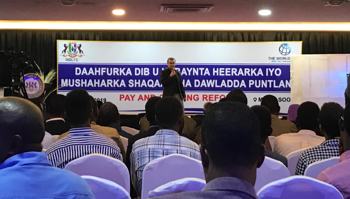
Puntland Pay and Grading Reform - Additional Services
- 2021 – 2022
- menos de 500.000 €
- Somalia
The World Bank has worked with the Federal Government of Somalia and the Government of Puntland State of Somalia to develop the Capacity Injection Project. The project supported an assignment promoting Pay & Grading Reform in Puntland from August 2019 to July 2020. World Bank, Government of Puntland State and the Capacity Injection Project were promoting the next phase of activities, namely further activities in support of building on the options presented in the completed assignment, to undertake the necessary steps to finalize and implement pay & grading policy solutions for Puntland.
The overall objective was to support pay & grading reform in Puntland based on international best practice.
The specific objective was to build on the previously undertaken work to gather and provide necessary information for the Puntland Government to allow Government to make informed decisions in determining a final pay & grading policy for Puntland.
Evaluation of WFP's Interim Country Strategic Plan in Algeria (2019-2022)
- 2021 – 2022
- menos de 500.000 €
- Algeria
This independent evaluation of WFP Interim Country Strategic Plan (CSP) in Algeria (2019-2022) assessed the strategic positioning, added value, and results of WFP’s operations in the country.
The evaluation served the double purpose of accountability (performance and results assessment) and learning (why certain results occurred or not, lessons and evidence for decision-making about a potential scale-up). It aimed at informing the design of the next CSP for Algeria.
WFP's operations in Algeria were implemented in the Sahrawi Refugee camps near Tindouf. Main activities included: general food assistance distribution, school feeding, social behavioural change communication, and livelihood activities.
The evaluation team conducted interviews with different stakeholders including WFP staff, WFP cooperation partners, Sahrawi authorities, as well as focus group discussions with beneficiaries.
The final evaluation report is available at: https://www.wfp.org/publications/evaluation-algeria-wfp-interim-country-strategic-plan-2019-2022
Training of secondary teachers in displacement-affected communities in the IGAD region (SIMPI project)
- 2021 – 2022
- de 2 a 5 millones de €
- Ethiopia, Sudan, Uganda
The main purpose of this project was to develop the capacity of secondary teachers to deliver quality education in refugee settings and host communities. Improving the quality of secondary school teaching has an accelerating effect and will enable refugee students to attend higher tertiary education or TVET programmes.
The project was implemented in 6 refugee settings/host communities, two in each of the three selected IGAD Member States (Uganda, Ethiopia, Sudan).
The delivered trainings on pedagogical, psychosocial, ICT and life skills enabled teachers in secondary refugee schools to better respond to the specific needs of refugee students. Under the supervision of the IGAD Secretariat the project worked closely together with the respective Ministries of Education and regional National Teaching Institutes in the selected Member States in order to strengthen their capacities to improve teaching quality and mainstream refugee education in their national education plans. The teacher trainings were elaborated and conducted together with the National Training Institutes of the regions where the refugee settings/host communities are, in order to improve the local and national capacities to tackle the main local challenges, as well as the sustainability of the initiative.
Female teachers were encouraged to participate during the selection process, in order to increase the participation of women in further training activities in all 6 refugee settings/host communities.
The provided support and advisory services brought on board various stakeholders from government, local authorities, international organizations, and foundations involved in refugee education in the selected IGAD Member States.
Evaluation of the European Union’s humanitarian interventions in disaster preparedness (2015-2020)
- 2021 – 2022
- menos de 500.000 €
- Global
The main objectives of the evaluation are to provide: i) an independent, retrospective assessment of the performance and results of the EU's contributions to disaster preparedness within its humanitarian action; and ii) strategic recommendations to support DG ECHO future actions in this field. The evaluation will generate lessons and insights to inform how DG ECHO and its partners continue to deliver effective and life-saving preparedness activities worldwide. The evaluation covers all disaster preparedness activities, both targeted preparedness and mainstreaming. Its geographical scope covers all countries in which DG ECHO carries out humanitarian interventions. In terms of temporal scope, the evaluation covers the six years from 2015-2020.
Consistent with the EC’s Better Regulation Guidelines, the evaluation will serve a dual purpose of accountability and learning:
- Accountability: the evaluation will assess the results of EU interventions against its aims and expectations, coherence with humanitarian principles, relevance of DG ECHO interventions in targeting the most vulnerable beneficiaries, addressing gaps and contribution to DG ECHO overall mission
- Learning: the evaluation will support DG ECHO internal learning by identifying best practices and areas for improvement, but also aims at sharing learning and knowledge within DG ECHO partners and the wider humanitarian and development sector.
Report available here: https://op.europa.eu/en/publication-detail/-/publication/bf6a3cc9-751f-11ed-9887-01aa75ed71a1/language-en
Final Evaluation - Low Carbon Action in the Republic of Korea
- 2022 – 2022
- menos de 500.000 €
- Korea (Republic Of)
Systematic and timely evaluation of its programmes and activities is an established priority of the European Commission. The focus of evaluations is on the assessment of achievements, the quality and the results of Actions in the context of an evolving cooperation policy with an increasing emphasis on result-oriented approaches and the contribution towards EU foreign policy objectives and the implementation of the SDGs.
From this perspective, evaluations should look for evidence of why, whether or how these results are linked to the EU intervention and seek to identify the factors driving or hindering progress. Evaluations should provide an understanding of the cause and effect links between: inputs and activities, and outputs, outcomes and impacts. Evaluations should serve accountability, decision making, learning and management purposes.
The main objectives of this evaluation are to provide the relevant services of the European Union and the interested stakeholders with:
=an overall independent assessment of the past performance of the SPIPA project, paying particular attention to its intermediate results measured against its expected objectives; and the reasons underpinning such results;
=key lessons learned, conclusions and related recommendations in order to improve current and future Actions in the field of energy, low carbon, climate issues and green financing.
Final evaluation of project MLI/804: Support for local economic development and conflict prevention in the regions of Gao and Timbuktu (ADEL)
- 2022 – 2022
- menos de 500.000 €
- Mali
This evaluation will allow:
- to know if the organization and the methods used for the implementation of the project are appropriate;
- to have an evaluation of the results achieved at the end of the project in relation to the objectives set in
beginning of the project according to the criteria of relevance, coherence, effectiveness, efficiency, impact and
sustainabilit
- to know the impact on the stabilization of the targeted municipalities, and courses of action
complementary for the continuation of the stabilization of the North of M
- to appreciate the involvement of the various stakeholders in the monitoring and implementation of the project
Evaluation of EU's Cooperation with Georgia (2014-2020)
- 2021 – 2022
- menos de 500.000 €
- Georgia
This evaluation has two overarching objectives. Firstly, to provide the relevant external co-operation services of the European Union (EU) and the wider public with an overall independent assessment of the EU's past and current cooperation with Georgia during the period 2014-2020. And secondly, to identify key lessons and to produce recommendations in order to inform the responsible decision makers, notably in NEAR and the EEAS, on how to improve the current and future strategies, programmes and actions of the EU.
In addition, the specific objectives for this evaluation are:
- Assess the performance (relevance, efficiency, effectiveness, coherence, impact,
sustainability and EU value added) of EU support (policy dialogue and financial
assistance);
- Provide recommendations for the next programming period.
The thematic scope of the evaluation covers: public administration reform; agriculture and rural development; justice sector reform; economic development and market opportunities; strengthening institutions and good governance, including rule of law; connectivity, energy security and efficiency, environment and climate change; mobility, people-to-people contacts, education; and complementary support.
It is intended to provide advice to EU external action actors, inform them about the result and impact of EU support, and contribute to improved programming, monitoring, reporting and implementation of current EU interventions in Georgia.
Publication: https://neighbourhood-enlargement.ec.europa.eu/system/files/2022-10/GEO%20CSE%20-%20Final%20Report%20-%20September%202022.pdf
Impact Assessment of the EU support in the PAR sector in BiH during 2004 - 2020 – ex-post evaluation
- 2021 – 2022
- menos de 500.000 €
- IPA
The main objectives of this assessment were the following:
1) The effectiveness of the EU assistance in terms of achievement of policy objectives (outcomes) and results along all PAR areas; covering (i) the extent to which the main beneficiary institutions have used/ translated the project deliverables into government actions or improved their capacities and implemented the Action Plan on PAR; (ii) impact assessment of the Technical Assistance on institutional reforms.
2) The adequacy of the EU assistance types vis-à-vis objectives of the programmes and vis-a-vis the needs that institutions had on PAR based on the objectives of the action plan on PAR where an Action Plan was available.
3) Effectiveness of the EU assistance in improving the implementation of PAR and functioning of the PAR coordination process in BiH, capacities of PARCO and PAR co-ordinators and the coordination structure at political and technical level.
4) The effectiveness of donor co-ordination in PAR sector with special focus on PAR fund.
5) Potential future support needs in ranked order, including analyse and recommendations concerning each aid modality.
Evaluation of the European Union Support to Sustainable Agri-Food Systems in partner countries (2014-2020)
- 2021 – 2022
- de 500.000 € a 1 millón de €
- Cambodia, Colombia, Haiti, Kenya, Malawi, Niger
The main purpose of this exercise is to produce an independent assessment of the past and current support of the EU in food and nutrition security, sustainable agriculture and fisheries at country, regional and global levels. The evaluation aims more specifically at:
- Informing strategic decisions on the implementation and future mid-term review of the new Multi-annual Financial Framework (MFF);
- Improving cooperation with EU partners under the new MFF and in the light of the new EU Sustainable Agri-Food Systems (SAFS) approach;
- Nurturing the design of new interventions in support of Agri-Food Systems transformations;
- Guiding choices for scaling up and replicating innovative/pilot approaches.
The evaluation covers non-spending (e.g., policy dialogue and advocacy) and spending activities funded under geographic (DCI Latin America, DCI Asia, EDF for Africa and Pacific and Caribbean) and thematic financing instruments (DCI-FOOD, DCI-ENV/DCI-GPGC, etc). The analysis considers interventions financed through other thematic budget lines such as the DCI-CSO&LA, and the Trust funds (e.g. the EU Trust Fund for Africa, Trust Fund Bêkou, Trust Fund for Colombia).
The temporal scope focuses on the MFF 2014-2020 and considers any major developments that occurred in 2021.
The geographical scope of the evaluation is essentially worldwide, but in practice will focus on 59 partner countries for which food and nutrition security or sustainable agriculture have been a priority sector in the previous MFF (2014-2020). A thorough selection of case studies identified a representative and evaluable sample of countries: Niger, Kenya, Malawi, Colombia, Haiti and Cambodia.
Following the 2020 4th Biennial Report and the 2019 EU Achievements Report, four EU priorities for addressing the challenges of food and nutrition security, as well as sustainable agriculture, are at the heart of the evaluation:
- Enhancing the resilience of the most vulnerable to food crises;
- Fostering specific nutrition outcomes;
- Increasing responsible investments in agriculture and food systems;
- Stimulating innovations for sustainable agri-food systems.
Monitoring and Evaluation of Somalia Country Programme (2019-2023) and Peace and Stabilisation Programme (2018-2022)
- 2021 – 2022
- menos de 500.000 €
- Ethiopia, Kenya, Somalia
The Somalia Country Programme (2019-2023) and Peace and Stabilisation Programme (2018-2022) operated in a political challenging and fluid context. In order to ensure proper tracking of the engagements and their developments, progress and results, both programmes, were receiving assistance in ensuring the necessary quality assurance of the management of the result frameworks, theory of change and the risks identified and reporting by setting up and running a robust monitoring and reporting system.
The overall objective of the Assignment was to support the Client in:
- establishing and facilitating a functioning MEAL including risk management system for the two programmes and their engagement documents based on an improved result framework, theory of change and risk set up in order for the Client to strengthen programme efficiency and effectiveness, facilitate learning and ensure informed decision-making by the Client and its partners related to the implementation and development of the programmes; and
- communicating to both the Somalia and Danish general public and other identified recipients, relevant achievements and results obtained by the two programmes.
The overall objective of the Somalia Country Programme (2019 – 2023) (SCP) was to contribute to: “Basic building blocks put in place for the development of a resilient, stable and peaceful Somalia based on responsive and inclusive governance and a growing and poverty-reducing economy”. The SCP contained three Thematic Programmes (TPs):
1) Strengthen resilient, responsive and inclusive governance able to deliver basic services and to promote and protect fundamental human rights.
2) Develop an enabling economic environment through core economic institutions and regulations and strengthen inclusive private sector led development and economic growth through critical and diversified livelihoods.
3) Develop protection and safety nets to enhance resilience, enable durable solutions and reduce forced displacement.
The main objective of the Peace and Stabilisation Programme (2018-2022) (PSP-HoA) was “improved peace and stability in the Horn of Africa by strengthening local, national and regional actors’ capacity and ability to manage conflict and insecurity, counter threats and exercise legitimate authority”. The PSP-HoA had three overriding Thematic Programmes (TPs):
1) Strengthened regional conflict management capacity and efforts of the actors engaged in promoting stabilisation and security in Somalia
2) Reduced levels of violent extremism in the Horn of Africa with a particular focus on Somalia through prevention and disengagement..
3) Improved capacity to exercise regional and governmental authority across land and maritime borders.