
Nuestros proyectos
Explore la experiencia de Particip en proyectos desarrollados en distintos países, sectores y ámbitos de especialización.
Nuestras referencias ofrecen una visión general de las misiones finalizadas y en curso, incluidos sus objetivos, alcance geográfico, duración y valor contractual.
Mostrando 591–600 de 980 referencias

EU communication campaign in Djibouti: Visibility of the EU's actions for Women and Employment in the Republic of Djibouti
- 2019 – 2020
- menos de 500.000 €
- Djibouti
The overall objective of the campaign is to consolidate the EU’s image as the main partner for Djiboutians, focussing on the values of the EU, in particular the promotion of women's rights and sustainable development resulting in job creation.
The specific objectives of this contract are:
a) Design and implement a communication campaign focussing on EU assistance to sustainable development resulting in job creation. The campaign aims at strengthening the image of the EU as the main support partner of Djibouti. In this context the project will:
- Define the target audience and its size (core target of the campaign, main target, secondary target);
- Define the communication message(s) and axis of the campaign that will support the actions and communication tools for each identified target audience. These messages should contribute to: (i) publicise EU actions in the field of employment promotion; (ii) assess the relevant results of the actions carried out; (iii) to positively change the perception of the target audience on EU support in the field of knowledge building and job creation;
- Identify for the campaign, the choice of media and supports (based on the defined budget and characteristics of the target audience) that will be produced and disseminated in order to contribute to a positive change in the perception of the EU and the image that the target audience has of it;
- Define the provisional budget allowing to have a realistic global vision of the project by taking into account the selected supports;
- Define a retro-planning to highlight the essential steps of the communication campaign;
(b) Design and implement a communication campaign focussing on the values of the EU, in particular the defence of the rights of women and girls. The objective of the campaign is to consolidate the image of the EU as Djibouti’s main partner. In this context the project will:
- Define the target audience and its size (core target of the campaign, main target, secondary target);
- Define the target audience and its size (core target of the campaign, main target, secondary target);
- Define the communication message(s) and axis of the campaign that will support the actions and communication tools for each identified target audience. These messages should contribute to: (i) publicise EU actions in the field of employment promotion; (ii) assess the relevant results of the actions carried out; (iii) to positively change the perception of the target audience on EU support in the field of knowledge building and the defence of the rights of women and girls;
- Identify for the campaign, the choice of media and supports (based on the defined budget and characteristics of the target audience) that will be produced and disseminated in order to contribute to a positive change in the perception of the EU and the image that the target audience has of it;
- Define the provisional budget allowing to have a realistic global vision of the project by taking into account the selected supports;
- Define a retro-planning to highlight the essential steps of the communication campaign;
(c) Define indicators to monitor the achievement of the results listed above, which are measurable and objectively verifiable, half way through and at the end of the implementation period of the communication campaigns.
Final evaluation of the Gouvernance Support Programme
- 2019 – 2020
- menos de 500.000 €
- Ivory Coast
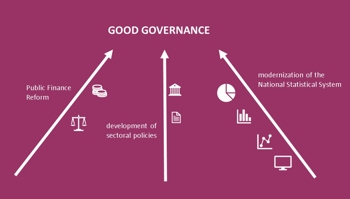
The overall objective of this programme was to contribute to the strengthening of the peace and recovery process in Côte d'Ivoire with a view to improving and promoting good governance. Situated at the crossroads of the main cross-cutting issues contained in the European Consensus on Development, the GAP supports the strengthening of governance in Côte d'Ivoire through 3 main components:
Axis 1. Support for the implementation of the Public Finance Reform for results-based budget management in line with the WAEMU Budget Reform.
- Component R1.1 - Institutional support to the Ministry of Economy and Finance (MEF) Component
- R.1.2 - Institutional support to pilot sectors of WAEMU reform: Component
- R1.3 - Support for institutional capacity building :
Axis 2. Support for the development of sectoral policies :
Contribution to the development of sectoral policies in certain key sectors that have a direct impact on poverty and the root causes of the crisis (health, education, water, sanitation, national identity/civil status, agriculture, rural land tenure, etc.), in line with the orientations taken in the framework of the WAEMU Reform, as well as in more cross-cutting sectors such as the environment (membership of FLEGT, Forest Law Enforcement, Governance and Trade), or decentralization :
Axis 3. Support for the modernization of the National Statistical System :
Institutional support to the National Institute of Statistics (NIS) in the implementation of the National Strategy for the Development of Statistics:
For the implementation of the GAP, in addition to equipment support granted to the structures involved in the PPPBSE chain and specific support to the Chamber of Accounts in the form of a PD, two technical assistance packages were mobilised, namely
- The Project to Support the Implementation of Results-Based Budget Management (PAGAR) for the "Reform of Public Financial Management" component; and ;
- the Project to Support the Planning and Statistics System (PAPS) for the components "Development of Sectoral Policies" and "Modernization of the National Statistical System (NSS)".
The assessment shows that the problems have been well targeted but less well addressed. Weaknesses were noted at the level of ownership of the programme by the ministries, the institutional anchoring of technical assistance, the synchronization of the two programmes, the monitoring of programme outputs, etc. The evaluation shows that the programme has been well targeted but less well addressed. All of these weaknesses have been identified and documented in the various evaluations and ROMs conducted on the project.
A mid-term evaluation with the main objective of providing stakeholders with an objective and reliable assessment of the implementation of the GAP with conclusions, recommendations, and lessons learned, likely to lead to proposals for updating, improving and revising the programme with a view to better implementation, based on the needs of the country and the performance achieved by the country in the governance sector was carried out from 23 November 2016 to 26 January 2017 by the evaluators of the DECG (Department of Evaluation and Management Control) of the National Authorizing Officer's Unit.
Evaluation of the Eastern Partnership Technical Assistance Trust Fund (EPTATF)
- 2020 – 2020
- menos de 500.000 €
- ENI East
The EPTATF was set up to accelerate the origination of operations in Eastern Partnership countries, and to improve the quality and development impact of the Bank's operations in the region. The establishment of the EPTATF was based on the assumption that technical assistance available at the time was inadequate to support the Bank’s operations in the region, particularly for small projects. It was set up to be complementary to the Neighbourhood Investment Facility (NIF) instrument and resources.
The purpose of the evaluation was to determine the extent to which the EPTATF has helped to improve EIB operations in Eastern Partnership countries since its establishment. Particip was expected to analyse the functioning of the EPTATF, its decision-making process, its governance arrangement and its organisation and performed a review of the EPTATF portfolio of TA operations.
The evaluation work encompassed the following main phases:
- Structuring phase: the evaluation team took ownership of the evaluation framework and approach, further amended and developed it, if deemed necessary.
- Data collection and analysis phase: this phase entailed a thorough desk review, data collection, validation and analysis. The analysis, focussing on 10 case studies of TA operations (at least three in Ukraine, and at least one in Armenia, Georgia, and Moldova) led up to the drafting of the Evaluation Report
- Preparation of the final report: the Team Leader participated in the presentation of the evaluation’s emerging findings to IG/EV and to the Evaluation Reference Group; and then drafted and finalised the Evaluation Report under the guidance of IG/EV

Preparation for Support to Property Rights in Albania
- 2018 – 2020
- menos de 500.000 €
- Albania
This project aimed to enhance the capacity of the relevant stakeholders to ensure proper administration, coordination and efficiency for compensation of former owners and finalization of immovable property
registration process.
The specific objectives of this contract were as follow:
- Identify key areas for immediate support and provide ad hoc advice on the compensation
scheme, legalization process and map digitalization
- Support the relevant stakeholders (Ministry of Justice and Ministry of Agriculture and Rural
Development, IPRO, ALUIZNI and ATP) to draft a Property Rights Reform roadmap in order
to address the key elements of the sector
- Prepare a set of recommendations to be addressed in the short and medium term in order to
prepare for the finalization of the compensation process and also finalize the immovable
property registry reform
- Prepare draft terms of reference for complementary technical assistance
- Draft a first assessment on the timeframe and necessary steps to be taken in order to prepare
for the implementation of the Land Parcel Identification System

Cyprus-Nicosia: Support to civil society organisations (CSOs) in the Turkish Cypriot community through, inter alia, tailor-made assistance, training, capacity building and networking with Greek Cypriot and other European Union CSOs
- 2015 – 2020
- de 2 a 5 millones de €
- Cyprus
The overall objective of the project of which this contract is a part is to strengthen the role of civil society in the Turkish Cypriot community as well as to promote EU values and the development of a conducive environment for the further development of trust, dialogue, co-operation and closer relationship between the Turkish Cypriot and Greek Cypriot communities and for the integration of Turkish Cypriot civil society into the wider Union by facilitating links with EU-wide NGOs and NGO networks.
The purposes of this contract are as follows:
- to increase and improve the capacity and actions of Turkish Cypriot CSOs;
- to increase collaboration and improve joint actions between Greek and Turkish Cypriot NGO;
- to strengthen CSOs role and civic engagement in the Turkish Cypriot community (TCc);
- to foster cooperation, support and exchange of best practices between TC CSOs and CSOs of the European Union as well as with EU-wide NGOs and NGOs networks.
External Evaluation of EU’s Support to Conflict Prevention and Peace Building (2013-2017)
- 2018 – 2020
- de 500.000 € a 1 millón de €
- Global
This evaluation took place in a context of a recent surge in violent conflicts and a renewed momentum on Conflict Prevention and Peacebuilding (CPPB) both at the EU and global level. Its purpose was to:
- provide the relevant EU Institutions and the wider public with an overall independent assessment of the EU support to CPPB focusing on the period 2013-2017; and
- identify key lessons, instil good practices, and produce recommendations to feed into ongoing and future approaches to EU’s engagement in the field of CPPB.
In particular, the evaluation will feed into the EU implementation of the Integrated Approach to Conflict and Crises and nurture future EU support to CPPB strategies and interventions.
The scope of the evaluation included:
- all relevant actions (including spending and non-spending activities) and all countries/regions which fall under the responsibility of DG DEVCO and DG NEAR (neighbourhood region only); and
- the work/engagement of EEAS related to them.
In terms of temporal scope, the evaluation focused on the period 2013-2018, but also took the period 2011-2012 into consideration in order to assess the evolution of EU support to CPPB.
Through the course of the evaluation, the evaluation team conducted 12 case studies (focusing on countries, regions and instruments) which were subject to an in-depth analysis, including eight field visits. Two surveys – one covering EU services in Brussels, the other covering EU Delegations/Offices worldwide – were also part of the data collection and analysis process. Findings from all evaluation activities were synthesized into a final report.
The final report is available online: https://ec.europa.eu/international-partnerships/external-evaluation-eus-support-conflict-prevention-and-peacebuilding-2013-2018_en

Support program for media in Tunisia
- 2017 – 2020
- de 5 a 10 millones de €
- Tunisia
The overall objective of this technical assistance project is to strengthen the professional media sector in Tunisia and to guarantee the dissemination of independent and pluralistic information guaranteeing freedom of expression.
Results to be achieved are, among others:
- Governments are strengthened in defining and exercising their roles and responsibilities in the development, implementation, monitoring, evaluation and monitoring of public media policies.
- Public media (radio, television and news agency Tunis Afrique-TAP) are strengthened in their vision and strategic capacities and have initiated internal structural reform.
- The economic viability of the media is analyzed and reviewed for their plurality and independence.
- Concertation structures ensure the participation of media professionals, civil society organizations, academics and citizens in the definition of public media policies.
- Ethics and editorial strategy are incorporated into the mainstream media.
- Media managers are strengthened in the management and direction of media companies.
- Media regulation and monitoring is structured and implemented by trained teams.
- Access to information for public institutions is reinforced by public communicators.
- The image of women in Tunisian society is valued and reinforced in the media.
- Young people are encouraged and strengthened by the experience and sense of leadership.
- School and out-of-school education for media understanding is strengthened.
- The social partners and civil society are strengthened in their decisions.
- The media training activity is decentralized and rooted at the regional level.
- Local deployment of regional radios, television and the Tunis Afrique Presse (TAP) national news agency is consolidated.
- Local media capacities are strengthened and their relations with local civil society strengthened.
- Media professionals, civil society organizations (CSOs) and citizens of the region are sensitized to issues of freedom of expression and the media.

European Union Election Expert Mission in Ivory Coast
- 2020 – 2020
- menos de 500.000 €
- Ivory Coast
The purpose of the Election Expert Mission (EEM) was to collect and analyse factual information, assess and report on the electoral process against international commitments, standards and good practice for democratic elections in line with the criteria contained in the Commission Communication on Electoral Assistance and Observation [COM(2000)191]. The experts also formulated recommendations to improve future electoral processes and assess, when relevant, the state of implementation of recommendations made by previous electoral missions.

Mid-term evaluation of the EU's 'Strategic Partnerships for the Implementation of the Paris Agreement (SPIPA)'
- 2020 – 2020
- menos de 500.000 €
- Global
Systematic and timely evaluation of its programmes and activities is an established priority of the European Commission. The focus of evaluations is on the assessment of achievements, the quality and the results of Actions in the context of an evolving cooperation policy with an increasing emphasis on result-oriented approaches and the contribution towards EU foreign policy objectives and the implementation of the SDGs. From this perspective, evaluations should look for evidence of why, whether or how these results are linked to the EU intervention and seek to identify the factors driving or hindering progress. Evaluations should provide an understanding of the cause and effect links between: inputs and activities, and outputs, outcomes and impacts. Evaluations should serve accountability, decision making, learning and management purposes.
The main objectives of this evaluation are to provide the relevant services of the European Union and the interested stakeholders with:
- an overall independent assessment of the past performance of the SPIPA project, paying particular attention to its intermediate results measured against its expected objectives; and the reasons underpinning such results;
- key lessons learned, conclusions and related recommendations in order to improve current and future Actions.

Support to the Assessment of the 2019 EIDHR Global Call for Proposals
- 2020 – 2020
- menos de 500.000 €
- Global
The global objective of this assignment was to support civil society in protection and promotion of democracy, human rights and fundamental freedoms worldwide.
The specific objective of this assignment was to provide technical support to the European Commission for the evaluation and selection of the proposals received under the 2019 EIDHR global call for proposals.