Our projects
Explore Particip’s project experience across countries, sectors and areas of expertise.
Our references provide an overview of completed and ongoing assignments, including their objectives, geographic scope, duration and contract value.
Showing 361–370 of 980 references
Development of Management Plans for Natura 2000 Network and Protected Areas - Group 2
- 2020 – 2023
- € 1 – 2 million
- Croatia
The purpose of this project was to provide effective management of areas of the ecological network, with the aim of contributing to a favorable state of preservation of endangered and rare species and habitat types at a biogeographical level through the development of management plans.
Group 2 consisted of the development of 37 management plans, which set out the goals and activities required for the conservation and management of the selected ecological network areas, enabling monitoring of the implementation of these activities and evaluation of their effectiveness.
The project consisted of 4 components:
- Component 1: Development of final drafts of the management plans
- Component 2: Engagement of Planning Assistants
- Component 3: Organisation of workshops
- Component 4: Engagement of Experts in Ecology of Species and Habitats
Development of Management Plans for Natura 2000 Network and Protected Areas - Group 1
- 2020 – 2023
- € 500,000 – 1 million
- Croatia
The purpose of this project was to provide effective management of areas of the ecological network, with the aim of contributing to a favorable state of preservation of endangered and rare species and habitat types at a biogeographical level through the development of management plans.
Group 1 consisted of the development of 14 management plans, which set out the goals and activities required for the conservation and management of the selected ecological network areas, enabling monitoring of the implementation of these activities and evaluation of their effectiveness.
The project consisted of 4 components:
- Component 1: Development of final drafts of the management plans
- Component 2: Engagement of Planning Assistants
- Component 3: Organisation of workshops
- Component 4: Engagement of Experts in Ecology of Species and Habitats
Final Evaluation of the European Union Budget Support SUSTAINABLE LOCAL DEVELOPMENT IN MARGINALIZED AREAS OF COLOMBIA - Phases I and II
- 2023 – 2023
- under € 500,000
- Colombia
The evaluation will take stock of all that has been achieved with the primary objective of enabling lessons learned and recommendations to inform:
- The conditions under which the budget support has an effect (or not) and the possible intensity and nature (positive or negative) of this effect on the Environment and Sustainable Development sector.
- The design and implementation of future budget support operations for the Environment and Sustainable Development sector.
- The improvements that will be implemented by the European Union (or other budget support provider(s)) to maximize the impact of budget support in the sector.
- Constraints in government policies, institutional structures and administrative arrangements in Colombia that may hinder the effectiveness of the budget support in financing specific actions and reforms and public policies.
Evaluation of Human Rights-Based Approach (HRBA) in Finland’s Development Policy and Cooperation
- 2022 – 2023
- € 500,000 – 1 million
- Global
The evaluation of human rights-based approach in Finland’s development policy and cooperation informed the Ministry on how HRBA has been applied in development cooperation during 2019-2021, how the approach could be implemented more effectively, and what its linkages with risk management are. The main users were the Ministry, the Development Policy Committee, different partners, actors and stakeholders.
The evaluation used a realist perspective, with contribution analysis providing an overall approach. A Theory of Change was developed. Context case studies covered long-term partnerships (Tanzania, Mozambique); HRBA in transition contexts (Zambia, Kenya, Vietnam) and HRBA in conflict contexts (Somalia, Kenya, Palestine).
Thematic cases on “Innovations and trends towards transformational development cooperation”; “HRBA in partnering with multilaterals”; “HRBA in severe headwinds” and “From cross-cutting objectives to HRBA, lessons from disability interventions” were completed. In addition to document review, over 250 interviews, three focus group discussions, and an e-survey among partners were undertaken. A separate component of the evaluation was the use of data science techniques for analysing documents.
Mid-term Review of the European Union Trust Fund (EUTF) Support Programme for Refugee Settlements in Northern Uganda (SPRS-NU): Livelihood and Labor Market Relevant Skills Development for Refugees and Host Communities
- 2023 – 2023
- under € 500,000
- Uganda
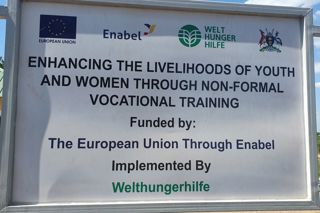
The mid-term review (MTR) of the Support Programme for Refugee Settlements in Northern Uganda (SPRS-NU) was commissioned by Enabel.
The Enabel-led component of SPRS-NU aimed to enhance the livelihoods of refugee and host communities through technical vocational education and training and entrepreneurship support. It was implemented in five districts of Northern Uganda (Adjumani, Arua, Madi Okolo, Terego, and Yumbe) and the Kiryandongo district in Western Uganda. The MTR assessed the first 22 months (from December 2021 to September 2023) of the last phase of the programme.
The MTR served the purposes of accountability (through performance assessment), and learning and steering (by explaining what works and does not work, and why, as well as through evidence-based lessons for other interventions and recommendations for decision-making). It addressed the six evaluation criteria of relevance, coherence, efficiency, effectiveness, impact and sustainability, as well as the cross-cutting themes of gender and environment.
Qualitative data were collected during a field mission in five of the six intervention districts (including stakeholder interviews, focus group discussions with direct beneficiaries, and direct observation) and in remote interviews. The review also drew on documents and existing quantitative M&E.
The executive summary of the review is available on the Enabel website: https://open.enabel.be/en/2208/doc/44108/mtr-summary
Evaluation of European Union's Cooperation with Papua New Guinea (2014-2021)
- 2022 – 2023
- under € 500,000
- Papua New Guinea
The general objective of this evaluation was twofold. Firstly, to provide the relevant external co-operation services of the European Union (EU) and the wider public with an overall independent, evidence-assessment of the EU cooperation with the Independent State of Papua New Guinea (PNG) between 2014 and 2021. And secondly, to identify key lessons and to produce recommendations in order to inform the responsible decision makers on how to improve the current and future strategies, programmes and actions of the EU in PNG.
Its specific objectives were the following:
- To assess the performance (relevance, efficiency, effectiveness, coherence, impact, sustainability and EU added value) of EU support (policy dialogue and financial assistance); and
- To provide recommendations for the next programming period.
The evaluation paid particular attention to the areas of i) Rural development and Rural Infrastructure; ii) Investment, Trade and Private Sector Development; iii) Education and Technical and Vocational Education and Training; iv) Water, Sanitation and Hygiene; iv) Good Governance including Public Finance Management; and v) Forestry, Climate Change, and Biodiversity. It led to the identification of conclusions, lessons learnt (both positive and negative), good practices regarding the achievement of the EU’s cooperation with PNG with a set of targeted and useful forward-looking recommendations for the improvement of the programming, assistance, and implementation of current EU interventions in the country.
Mid-term Review of the Beekeeping Value Chain Support (BEVAC) Programme in Tanzania
- 2023 – 2023
- under € 500,000
- Tanzania
The mid-term review of the Beekeeping Value Chain Support (BEVAC) Programme in Tanzania was commissioned by Enabel.
BEVAC aims to enhance the beekeeping industry's contribution to inclusive economic growth in Tanzania. The specific objective is that quality honey produced in an environmentally sustainable manner leads to increased market penetration. BEVAC runs from 2021 to 2024 in seven regions of Tanzania (Kigoma, Katavi, Tabora, Singida, Shinyanga, North Pemba and South Pemba) with a total budget of EUR 10 million.
The mid-term review served the purposes of accountability (through performance assessment), and learning and steering (by explaining what works and does not work, and why, as well as through evidence-based lessons for other interventions and recommendations for decision-making). It addressed the six evaluation criteria of relevance, coherence, efficiency, effectiveness, impact and sustainability, as well as the cross-cutting issues of gender and youth empowerment, among others.
Qualitative data were collected during a two-week field mission (including stakeholder interviews, focus group discussions with leadership and members of cooperatives, and direct observation) and in remote interviews. The review also drew on documents and existing quantitative M&E and survey data.
Governance for Inclusive Development (GovID) in Ghana
- 2020 – 2023
- € 5 – 10 million
- Ghana
The project Governance for Inclusive Development (GovID) in Ghana aimed to contribute to the development of Governance by improving transparency, internal accountability, participation, decentralisation, and provision of public services and public finance management (PFM) so that national and sub-national Governance actors are able to finance inclusive development in Ghana.
The consultancy provided advisory services delivered by a national long-term expert, who managed a pool of international, regional and national short-term experts in the form of technical consultancy services. The key intervention areas were to:
- strengthen revenue management at the national level;
- strengthen municipal capacities for collecting internally generated funds (IGF) at the sub-national level;
- strengthen capacities for inclusive budget management at national and local levels;
- strengthen accountability mechanisms for budget execution;
- enable subnational public actors to identify and further develop local economic development potentials in cooperation with medium-sized enterprises in the agricultural and food industries.
To implement this strategy, the project combined measures in all ++three areas of capacity development++. At the individual level, the project trained technical and managerial staff to implement the reform elements in the selected institutions and organizations. At the organizational level, the project supported the relevant stakeholders at the national, regional and local levels through organizational, strategy and process development that strengthen their mandates in the design and implementation of domestic revenue mobilisation (Ministry of Finance (MoF), Ministry of Local Government and Rural Development (MLGRD), Ghana Revenue Authority (GRA), local authorities), the evidence-based budget planning and reliable allocation of funds (MoF, selected sectoral ministries, local authorities), accountability over the use of funds (Internal Audit Agency (IAA), audit committees, Court of Auditors, local authorities, civil society), and demand-oriented regional economic development (municipalities, medium-sized enterprises of agricultural and food industry). At the cooperation and societal level, the project supported the partners in the establishment of joint working groups and cooperation procedures and the development and adaptation of regulatory frameworks.
Project appraisal: Rural Economic Development (RED) Phase I in Ethiopia
- 2023 – 2023
- under € 500,000
- Ethiopia
This appraisal reviewed the Project Document (PD) for the 'Rural Economic Development' (RED) Project Phase I in Ethiopia. The main focus was on the overall feasibility of the program, including its theory of change (TOC) and results framework, resources and implementation and management arrangements, and how they contributed to a sustainable impact.
The main issues studied included: a review of the TOC and the results framework, including the provisional indicators; a review of how the project design catered for adaptive management; an assessment of how well local ownership, capacity, and commitment were demonstrated in the PD.
Other specific issues included: project management, organisational and administrative arrangements, financial management and audit arrangements, the cross-cutting objectives related to environmental and climate aspects, the risk assessment and risk management plan, linkages with other ongoing or planned programmes in the sector, possibilities for cooperation with Finnish companies, and a review of the proposed budget to verify that it was in proportion to expected results.
The appraisal was based on the draft PD, taking into account the identification mission report and the reports and reviews of the current programmes, MFA quality assurance group documents, as well as other relevant documents. The appraisal was done as a desk review.
Technical Assistance to the EU Cooperation Support Facility II (CSF II) Programme
- 2019 – 2023
- € 2 – 5 million
- Timor-leste
The overall objective was to promote inclusive and sustainable socio-economic development of Timor-Leste. The purpose was to increase the effectiveness of National Authorizing Office (NAO) services in delivering the EU - Timor-Leste development cooperation.
The Cooperation Support Facility was designed to contribute to the succesful preparation, implementation, evaluation, and visibility of the development cooperation between the EU and Timor-Leste, aminly through the increase of the effectiveness of NAO services in delivering the EU-TL development cooperation.
The project placed particular emphasis on supporting Timor-Leste’s efforts towards regional integration and enhancing its presence on the international stage. This was achieved through technical assistance provided for the review of Timor-Leste’s Market Access Offer and a detailed cost-benefit analysis aimed at facilitating the country's accession to ASEAN. The project also prioritized capacity building through workshops and dialogue sessions with key stakeholders to ensure alignment with international standards, increasing the visibility of EU-Timor-Leste cooperation efforts, and ensuring that communication and visibility campaigns were effectively implemented to promote both social development initiatives and environmental awareness, such as the EU Plastic Reduction Campaign.
The results to be achieved were as follows:
- Result 1: Improved capacity of the NAO office to oversee programming, identification and evaluation of programme and projects.
- Result 2: Improved capacity for programme implementation of line Ministries and other stakeholders in focal sectors in line with EU policies and strategies.
- Result 3: Increased visibility of the EU - Timor-Leste cooperation and greater awareness on EU and its Member States’ fundamental values, history and culture.
Implemented projects include the following:
- Support services to the launch event of the Skills for Employment and Resilience project.
- Support services for the realization of the Policy Dialogue Meeting on EU Budget Support for Partnership for Improving Nutrition in Timor-Leste (PINTL).
- Support services for the realization of the Policy Dialogue Meeting on Supporting Programme to Deconcentrating and Decentralization process in TL (SPDD-TL).
- Support services for the organization of TL Civil Society Organisations Dialogue.
- TA for support TL Market Access Offer and Cost Benefit Analysis to integrate ASEAN, which included a Synthesis of the meetings with the stakeholders, and beneficiaries; Review of the Timor-Leste Market Access Offer and Cost Benefit Analysis to accede to ASEAN; Power Point Presentation of main findings and recommendations for a validation workshop; Inception Report, Draft Final Report and Final Report.
- Support services for the acquisition of EU-TL Cooperation Visibility and Communication products.
- Support services to the organization of the Photo competition: “Skills and Crafts – The role of women in transferring knowledge and handicraft.
- Support services to EU Plastic Reduction Campaign.
- Organization of Communication & Visibility workshops.
- Support the construction of a Bordalo II’s artwork in Dili
- Support services for the acquisition of a European Union Visibility Item – Backdrop
- Support services for printing projects fiche form